


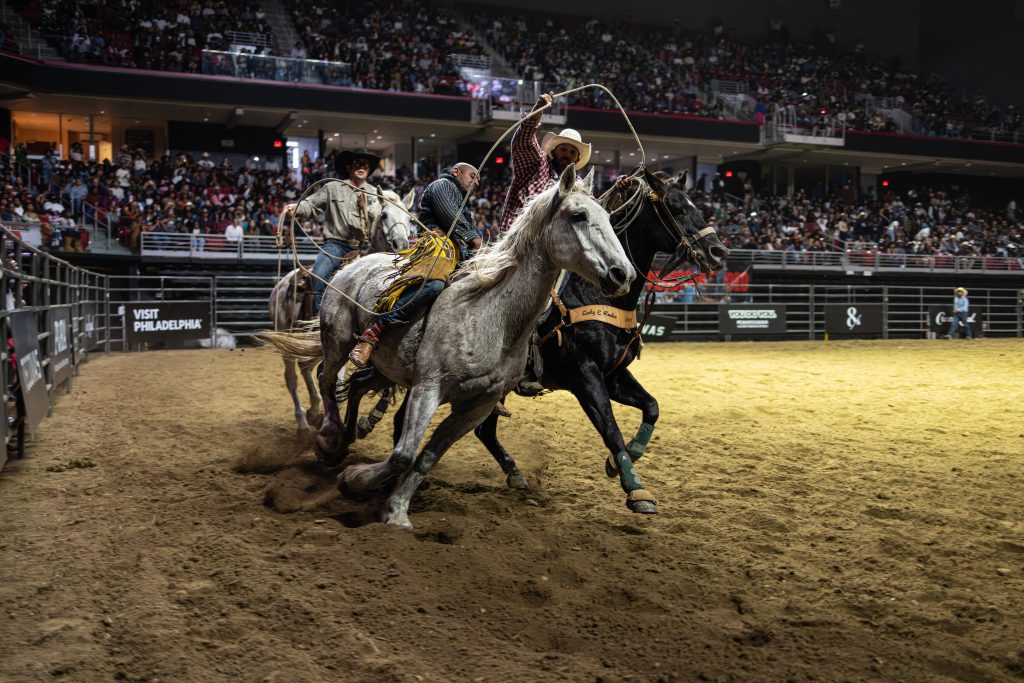
On Oct. 11, Ivan McClellan brought his 8 Seconds Rodeo to Philadelphia for the first time—a vibrant celebration of Black culture, community, and cowboy heritage. What began as McClellan’s personal photography of Black rodeo athletes has grown into an all-Black rodeo that has now been held in three major U.S. cities.
The founder of 8 Seconds Rodeo has been fascinated by cowboy culture for as long as he can remember. As a kid, he was obsessed with the 1993 film “Tombstone,” but years later, he realized something: none of the characters looked like him—or like the Black cowboys he knew existed. “There wasn’t even a Black horse in that film,” he recalled. “Even when I became aware of Black cowboys, I didn’t call them cowboys because I didn’t feel like I had the permission to.”
That realization became the foundation of his mission: to reintroduce America to its Black cowboy heritage. “I hope that when kids go to draw a cowboy, they color their skin with a brown marker.” McClellan said.
It is important to clarify that 8 Seconds is not presenting something new, but rather drawing attention to a tradition that has existed for generations, dating back to the very foundations of the American South. While 8 Seconds introduces a modern form of rodeo, it serves to highlight and honor history—not to create it.
Before becoming a photographer, McClellan worked in advertising and marketing—a career that left him creatively unfulfilled. “It was very technical, very stale,” he said. “I just sort of stumbled into photography. After work, I’d go out on the street and take pictures.” Eventually, he found himself at a rodeo—and everything clicked.
“I was in absolute bliss,” he said. He was particularly captured by the black cowboys he would photograph at the rodeos. “These athletes are rare and extraordinary. Fewer and fewer exist every year. So when I get the opportunity to shoot these folks, I do it with joy—for the culture.”
McClellan describes rodeo photography as an “incredibly technical genre,” but his approach is more human than documentary. Rather than focusing on the arena, he often photographs “the moments in between”—a cowboy holding a rope backstage, a quiet exchange between riders. He cares about representing these athletes authentically: “I’m deeply embedded in this world,” he said. “If I don’t represent something accurately, I’ll hear about it from these cowboys.”
In McClellan’s eyes, 8 Seconds Rodeo is not just a competition—it is a representation of culture. “In the rodeo world, we’re kind of seen as disruptors. This is not a traditional rodeo in any sense of the word,” he said. “Someone once called it a ‘showdeo,’ and at first I was offended. But the more I thought about it, that’s the perfect way to phrase it. Culture and community come first—rodeo comes second.”
That spirit was on full display in Philadelphia. Before the rodeo started, there was an electric bull available for guests to test their bull-riding skills, line dancing lessons, multiple cowboy hat and cowboy boot customization vendors, and a lassoing practice area. The event opened with a horse circling the arena, the rider proudly carrying a Pan-African flag as the Baptist Tabernacle Choir sang “Lift Every Voice and Sing.” Throughout the night, DJ Diamond Kuts was DJing and the crowd was lively from the mutton busting at the beginning to the awards ceremony at the end. Before the final round of rodeo events, the West Powelton Stepper and Drum Squad performed a routine in the arena. With 50 dump truck loads of dirt in the Liacouras Center, McClellan turned the night into part rodeo, part cultural revival.
The competition itself was fierce: Tank Adams won the bareback riding event, Amber Perez took the barrel racing title, and 19-year-old Savion Strain of Oklahoma captured the bull riding crown. The athleticism of the cowboys and cowgirls was on full display as the horses bucked with intensity or raced at full speed and the bulls did everything they could to throw off their riders.
Among the competitors was Malachi Anderson, a 23-year-old self-taught bull rider from Arkansas who won last year’s 8 Seconds bull riding competition in Portland. For Anderson, traveling with McClellan’s rodeo feels different from the traditional circuit. “It’s more homey, and I can take a deep breath,” he said. “This one feels like family.”
Also present throughout the night were members of the Fletcher Street Urban Riding Club—more commonly known as the Concrete Cowboys—of North Philadelphia. These riders have been a fixture in the city for nearly a century, serving as a cornerstone and powerful symbol of urban cowboy culture. They gained worldwide recognition through the 2020 Netflix film “Concrete Cowboy,” which portrayed a tight-knit community of Black cowboys in North Philadelphia. Their presence at the event served as an important nod to the city’s rich history of Black urban horsemanship and a reminder that this culture continues to thrive and deserves to be celebrated.
At the end of the night, McClellan was presented with an award by Tony Herbert, Co-Founder of the National Urban Black Cowboy Alliance, for his work preserving and highlighting this community. It was an excellent reminder that McClellan is primarily invested in the people who make the event possible. “These cowboys are everywhere—even in a city as white as Portland, Oregon,” he said. “If you look hard enough, you’ll find them. Independence and grit—that’s what they represent. They’re authentic. They’re the real thing.”