


What began as a school rooted in domestic economy and practical instruction has grown into one of Drexel University’s most dynamic creative institutions. The Antoinette Westphal College of Media Arts & Design’s century-long history is one of continual reinvention, shaped by shifting cultural values, emerging industries, and the changing role of creative work itself.
In the 100 years since The Triangle was founded, the Antoinette Westphal School of Arts and Design can be traced back to something that was a bit different. Westphal was known by many names before the name students know it as today. Originally, in 1891, it was known as the Department of Domestic Economy (1891-1894), then known as Departments of Domestic Sciences and Arts (1895-1914), the School of Domestic Science and Art (1914-1922), and the School/College of Home Economics (1922-1967).
In 1967, the CHE launched an experimental program, called Pilot ‘71 — 1971 would be the graduation year of the participating students. The program focused on design and fine arts. By 1974, these changes became permanent, shifting the CHE to a new college, called Nesbitt College of Design, Nutrition, Human Relations, and Home Economics. After 1974, the college continued to focus heavily on the element of design and slowly took away the homemaking courses. By the early 2000s, the college had several arts programs, and in 2001, the college was renamed Westphal College of Media Arts and Design after a former student. This shift solidified the college as a growing leader in the field of Arts.
The college was originally founded to provide, specifically women, courses of study. Classes included cooking, dressmaking, and other domestic arts. This curriculum was later expanded to include domestic science, home economics, dietetics, and childcare. Over time, the college added other courses including design, applied and performing arts, and slowly stopped offering domestic courses.
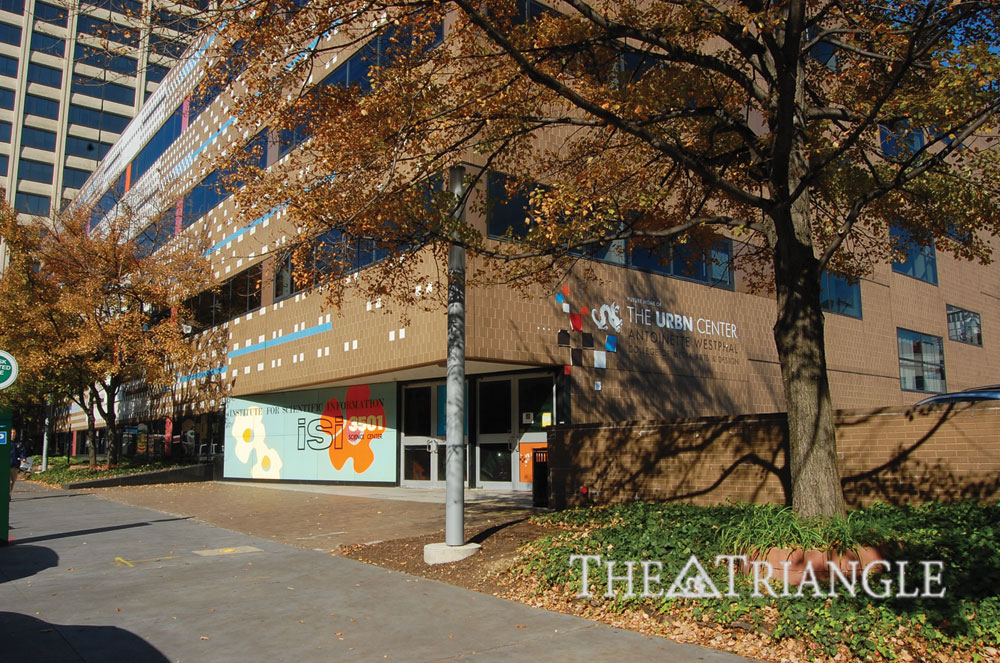
In 2011, a major renovation to the URBN center was announced, which both added many new programs to the college and enhanced the space, adding workshops, labs, and studios throughout the building. This architectural change encouraged learning in program specific environments, a hallmark of Westphal’s current programs. Architects wanted the building to look high tech, and more specifically, urban. Their vision for the new building describes what students of Westphal know today: a building with lots of windows, mezzanine levels surrounding an atrium, and having everything open and raw, showcasing metal beams.
The space is intentionally mute in terms of color, “There’s the gray concrete floor, the reddish, exposed steel, the piping and HVAC system above — you can see how it’s all connected, but the color that’s eventually going to populate the space is going to be derived from the artwork. […] It’s the students that are going to be adding the color to this place” said Simone Pucca-Fera, the URBN Center’s project manager consultant, to Drexel Magazine.
Now, as Drexel University describes it, the Westphal College of Media Arts and Design is the creative heart of the university, offering 19 undergraduate programs and eight graduate programs, spanning disciplines from fashion design, digital media, game design, architecture, dance, to disciplines in the visual and performing arts. The college focuses on the experimental and the experiential, and the students work hands-on to master their craft in program-intensive courses and workspaces, and helps not only prepare them for creative industries, but actively helps shape them.
Rather than large-scale classes, the courses are designed to be personal and intimate, emphasizing interdisciplinary, studio-based learning that reflects how creative industries run in the real world. Fashion students engage with sustainability and global supply chains, media and digital design students explore emerging technologies and storytelling platforms, and performing arts students contribute to public-facing cultural production. Across programs, making is paired with critical thinking, asking students to consider ethics, history, technology, and social impact alongside craft.
The Pew Center for Arts and Heritage states on their website that “The college’s curriculum integrates studio education and experiential learning with the study of aesthetics, function, history, ethics, technology, economic realities, and the importance of addressing the pressing issues of the time.”
The Westphal College of Art and Design is also deeply connected with the Philadelphia community, hosting research projects and other initiatives that are dedicated to improving the city and livelihoods of its citizens. A few examples listed by the Cumulus Association are “a cutting edge VR project for a Fortune 500 fashion company project around letting customers digital try on clothes at home, a project with the Curtis Institute of Music that will produce national and international artists across the city in unexpected places – one of the largest production efforts in the history of the city, and much more.”
The college emphasizes sustainability practices, access, collaboration, equity in creative practice, global learning, the co-op program, and creating the next generation of creatives. Westphal positions itself as not only an instructional institution, but a participant in contemporary culture.