


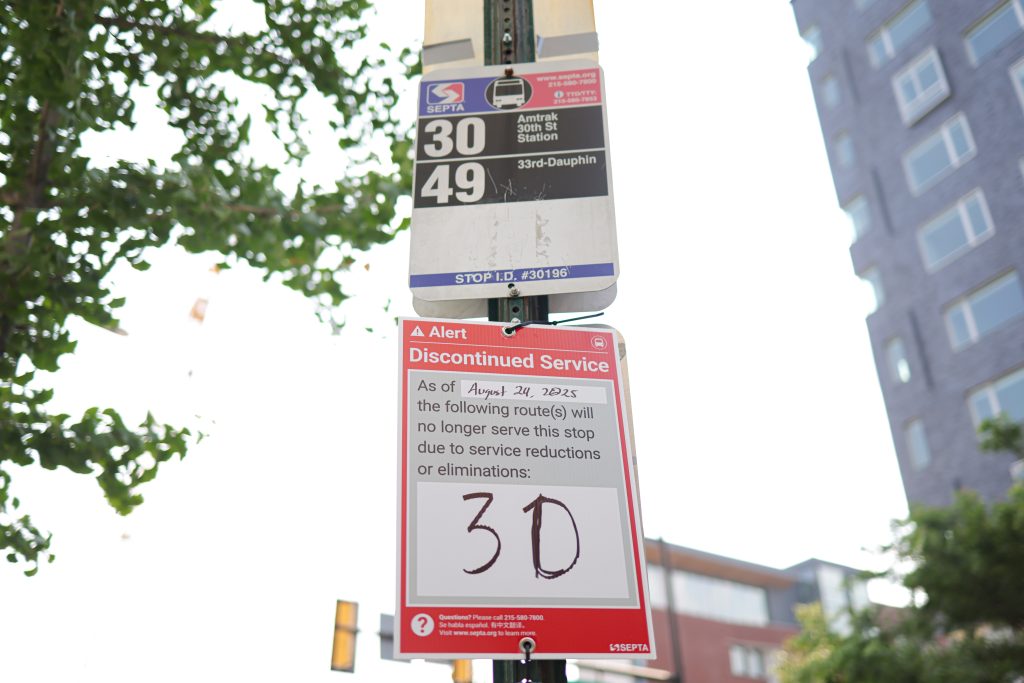
SEPTA is set to begin drastic service cuts effective Sunday, Aug. 24, as state lawmakers remain deadlocked on the passage of long-term transportation funding.
With no progress in sight, the transit agency will begin implementing its long-foretold “doomsday budget” with 20 percent service reductions affecting its bus, trolley, subway and light rail (Metro) operations, which are sure to be felt on campus next week. Service will be cut by a further 25 percent effective January 2026.
The impacts of the funding shortfall extend beyond SEPTA: this week, Amtrak warned that its Keystone Service from New York to Harrisburg will be in jeopardy without the annual operating subsidy it receives from SEPTA. Agency-operated school bus routes serving the School District of Philadelphia also stand to be eliminated, complicating commutes for public school students. ADA-accessible transit services will also be discontinued to any riders who no longer live within ¾ of a mile of transit routes.
Here’s what to know about transportation to and from campus beginning Sunday.
Fares
There will be no change in bus or Metro fares until Monday, Sept. 2, when a 21.5 percent fare increase will go into effect. This will bring the standard fare to $2.90 — matching New York City public transit. Regional Rail fares will increase for each zone.
Fare pass prices are also expected to increase: see SEPTA’s website for further details. For those who use Drexel’s ComPass program to purchase a SEPTA TransPass or TrailPass, the discount is rising to 15 percent. The 5 percent difference is being funded by the university.
Buses
In total, 32 bus lines will be cut entirely beginning Sunday and Monday.
Route 30 will be discontinued entirely from University City to 69th Street.
Route 31 will be discontinued entirely from City Hall to 76th Street and City Avenue.
Overnight bus shuttles for the Market-Frankford and Broad Street Lines — the Owl services — will be discontinued entirely.
For these routes, see SEPTA’s website for suggested alternative routes.
Remaining routes will see significant changes, either in route or frequency. Peak (rush-hour) frequencies will increase for most.
Route 38 will maintain its start and end, but will be rerouted to Market Street via 34th Street, bypassing Spring Garden Street and the Ben Franklin Parkway. Off-peak headways will increase from 20 to 30 minutes.
Route 43 will be shortened, travelling from Parkside Loop to the MFL at Spring Garden Station. Peak headways will increase from 16 to 20 minutes.
Route 44 service to Narberth and Gladwyne will be discontinued, leaving only service to Ardmore. Peak headways will increase from 15 to 20 minutes.
Routes 124 and 125 will be significantly altered, with neither serving Center City. Route 124 will be shortened into a circulator service between Gulph Mills Station, the King of Prussia Mall and Chesterbrook. Route 125 will provide service between 30th Street Station and the King of Prussia Business Center via Wissahickon Transit Center and Gulph Mills Station.
Routes 21, 42 and 49 will see peak and midday headways increase.
Metro (trolleys, subways and light rail)
Trolley and subway services will be reduced by 20 percent, translating into slight headway increases at peak times and moderate increases off-peak. See SEPTA’s website for more detailed information per route.
The Sports Express service — the trains available after matches in the Stadium District — will be discontinued beginning Aug. 24.
Regional Rail
No routes will be eliminated before Sept. 2. First, all will face service reductions: the Airport Line will run hourly, all express services will be eliminated and weekend service will be reduced to every two hours.
If funding is not guaranteed by Aug. 24, ten days before rail schedules are set to take effect, expect five routes to be eliminated: the Trenton Line, Chestnut Hill West Line, Cynwyd Line, Paoli-Thorndale Line and Newark Line.
SEPTA is already running service with delays and cancellations due to an equipment shortage. With investigations into two onboard fires this year ongoing, the agency is withdrawing much of its older rail equipment for maintenance. Some of the affected rail cars entered service in 1974 during the Nixon administration.
Alternatives
PATCO, Amtrak and NJ Transit service will be unaffected by the cuts this year.
For students needing to get around the city, biking could be the move: IndeGo bike rentals are available at multiple locations on campus and throughout the city. IndeGo offers monthly rates.
However, there are few alternatives for transportation throughout the region beyond driving, be that a personal vehicle, carpooling or rideshare.
A funding solution?
Last week, state Republican leadership proposed dipping into the Public Transportation Trust Fund to partially fund SEPTA operations. The PTTF was established for capital projects like construction and vehicle purchases, and currently has a balance of $2.4 billion.
Approximately $1.3 billion is already earmarked, according to PennDOT, which Republicans argue leaves the remainder available for use. SEPTA management refuted this, pointing to a $10 billion maintenance backlog, and PennDOT urged caution in spending capital funds for operating expenses.
Another point of contention has been placing a tax on so-called skill games, the slots-like consoles found in many of the state’s bars. Lobbying efforts for and against the tax this past year have been contentious and downright strange at times.
Above all, legislators from Pennsylvania’s rural counties — including Senate President Pro Tempore Kim Ward — have expressed skepticism about the seriousness of the service cuts.
However, the Delaware Valley Regional Planning Commission has made an effort to quantify the effects in real terms. If the 45 percent total service reduction planned for January is enacted, traffic planners suggest as many as 275,000 vehicles per day will be added to the region’s roads — roughly equivalent to the entire population of Pittsburgh.