


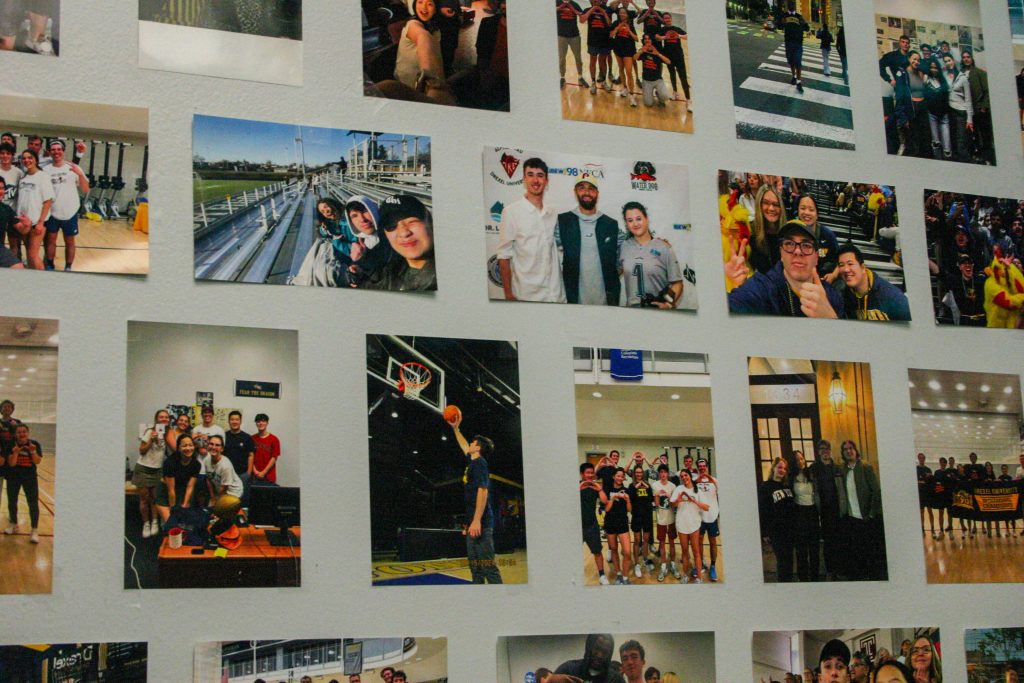
At 9 p.m. on Thursday nights, not many people are on campus. That is, except for a handful of students in the basement of Creese, working hard to produce a newspaper. Laptops are open, music is playing, debates are underway, and deadlines are approaching. A familiar rhythm sets in.
As it turns out, production night has not changed that much over the past 50 years. Writers raced to finish stories, editors made last-minute changes, and the layout team figured out how to fit it all together. Everyone relies on each other to get the Triangle into the stands by Friday morning.
To mark The Triangle’s 100th anniversary, former sports editors from the past five decades reflected on their time as the storytellers of Drexel sports: what stayed the same, what has changed, and why The Triangle was such an important part of their time at Drexel.
For the sports team, the most exciting time to write was from November to March. “The sports section was probably the most interesting, especially during basketball season, with no football team. Basketball was 90 percent of what we wrote about,” said Francis Wisniewski ‘96.
Wisniewski was The Triangle’s sports editor during Drexel’s best basketball seasons, when Malik Rose led the team to three straight NCAA tournament appearances. School spirit was at an all-time high. “In the final game of the season [at the DAC], we had wooden stands still. The fans broke the stands from jumping up and down so much. The stands bent, and they couldn’t push them back in, so they had to replace all the stands. The crowds were great.”
While the men’s basketball team may not have reached the same glory since then, it did not stop reporters from covering the team with the same passion. For former editor Mike Mazzeo ‘10, this literally meant following the team wherever they went. “I would hitch rides with other fans. If we played 32 games, I was probably at 27. We would hitch rides to George Mason, VCU, and Towson.”
If he could not find a ride, Mazzeo would travel with the team. “I got to fly on the team charter once, when we had a Triangle budget for big events. It was definitely trains, planes, and automobiles.” Writing for The Triangle took him across the country, from Albuquerque, New Mexico, to Lexington, Kentucky.
Despite supportive coverage of sports in The Triangle, the long-standing perception that Drexel is not known for school spirit still exists. Current editor-in-chief Paulie Loscalzo ‘26 kept that in mind while he was the sports editor. “I think one of the narratives [The Triangle] tries to combat is that we suck at everything, and I don’t think that’s true.”
This is something editors across the decades were aware of when writing about the success of student-athletes. Since the start of The Triangle, writers have always been in a unique position to cover sports, as they were students themselves. “What made The Triangle special was that we covered Drexel. We knew the athletes, the teams that we saw every day, and went to classes with these people, so I really wanted to have my focus on that,” said Brett Fischer ‘09.
After the reporting was done, Kurt Ritzman ‘07 remembers the pressure of getting late games into the paper. “I can remember having disagreements with my writer on games that were on print days. I’m rushing him, saying this is how much space we have. He says, ‘This game was better. I need 30 inches,’ and I said, ‘No, you have 20, you’ve got to get going.’”
“Thursday night basketball games meant fast turnarounds, no excuses, and total reliance on the people around you,” said Fischer. The grind of producing a weekly newspaper was something “we just did,” recalled Bryan Fyalkowski ‘14. “We were like 22 years old, this is what we do. They’re like, find a way to do it, and hopefully you would get out of there by 11.”
Even though the nights were long, they were definitely not as involved as production in the ’80s. Without laptops, making a newspaper looked a lot different. “We literally had to paste up the newspaper at the printer,” said Anthony Cirillo ‘80. As technology evolved, constructing the newspaper by hand turned into creating layouts digitally.
What stayed the same decades later was the energy of production night. As Chris Meloy ’07 reminisced, the liveliness often escalated as the night went on. “We had this set up, there were side offices and the main bullpen as the press room. At any hour, it seemed that the bullpen was teeming with activity. There was always pizza, chicken wings, cheesesteaks, and everything just all the time, constantly.”
In previous decades, editors at The Triangle struck up deals with local businesses, like Ed’s and California Pizza. The deal was that businesses received a free ad in the paper if they provided the newsroom with food. Many editors, including Wisniewski, admitted that the free pizza was a major incentive to hang out in the office. “As a poor junior and senior, I would eat at The Triangle, literally, almost every night.”
Spending that much time in the office led to close relationships being formed through the shared experience. “I spent so much time in the office with the other editors. It was just fun spending time in the office, putting our heads down and doing work together,” said Meaghan Geatens ‘17.
Producing a paper is hard work. It takes time, commitment, and dedication. For Cirillo, his schedule revolved around The Triangle. “It was Tuesday night, Wednesday night, and Thursday morning. I always scheduled no classes for Thursday.”
Despite the constant pressure and late nights, what made people come back was the community. Everyone was working towards the same goal: producing a newspaper they could be proud of. Today, that is still true.
Once it hits midnight on Thursday, editors breathe a sigh of relief. Articles are edited, photos are up, and the paper is ready for students to read at 9 a.m. on Friday. Another successful week producing a newspaper. People leave the office, ready to do it all again the next week.
For some editors like Fyalkowski, the experience at the newspaper helped him discover his passion for journalism. “Writing for The Triangle catapulted me into my career, working closely with athletic communications people. I didn’t even realize that was a career path.”
Others credit The Triangle for being a defining part of their college experience. To the former sports editors over the past five decades, The Triangle has always been more than writing game recaps. It was about belonging to a community of people who cared about something greater than themselves.
As said by Meloy, “I never had any goals; it was all just for the thrill of the experience and doing it. It was the excitement of being involved in The Triangle. That’s the thing you’ll remember in 20 years from now, when someone’s interviewing you.”
Interviews have been edited for length and clarity.